
 Nov 09,2026
 By:
Overview
Shop Your Perfect Fridge Now 🛒Buying a fridge feels simple until you're standing in a showroom, staring at forty models that all look like white or grey boxes. This blog breaks the decision into plain steps. You'll see how family size maps to litres, how a single door and a double door fridge really differ, when large capacity refrigerators are worth it, and how energy-efficient refrigerators can quietly cut your electricity bill. Then come a quick matching table, a measuring checklist, final thoughts and three FAQs. Ready to compare models in person or online? MediaMarkt is a good place to browse fridges across sizes and budgets.
Refrigerator Size Guide: Start With Your Family, Not the Showroom
Capacity is measured in litres, and it's the first number you should care about. Too small, and you'll be playing Tetris with milk packets every evening. Too big, and you'll pay more upfront and burn extra power cooling empty shelves.Here's a rough rule that most appliance people agree on: plan for about 50 to 60 litres per person, then add a little buffer for guests, festival cooking and that one relative who always arrives with a box of mangoes. It's not science. It's a starting point.
A few real-life things change the math:
- How often you shop: If you buy vegetables twice a week from the mandi or the local cart, you need less space than someone doing one big monthly run.
- How much you cook at home: Batch cooking, leftovers, dough, curd setting, all of it eats shelf space.
- Frozen food habits: Ice cream, frozen peas, meat, ready parathas. A single door fridge has a tiny freezer, so if you freeze a lot, think twice.
- Guests and functions: Hosting often? Size up a notch.
Single Door vs Double Door Fridge: Which One Fits Your Life?
This is the debate that never dies in Indian households, so let's settle it with facts.The single door fridge
A single door fridge has one door, and the freezer is a small compartment inside at the top. Most are direct cool models. That means the cooling happens through contact with the walls, and you have to defrost the freezer manually every few weeks.
- Good for: individuals, couples, bachelors, small flats, hostels, a second fridge for drinks.
- Why people like it: lower purchase price, simple design, fewer parts to go wrong, and efficient in its own way because the cooling system is basic. Capacities usually sit between roughly 100 and 250 litres.
- The catch: manual defrosting is a chore, the freezer is cramped, and you can't store much frozen food. Ice builds up. You'll know it when you see it.
Here the freezer sits in its own separate compartment with its own door, usually on top (or sometimes at the bottom). Most double door models are frost free, which means they clear ice automatically. No scraping. No dripping towels on the floor.
- Good for: families of three or more, anyone who stores a lot of frozen food, people who hate defrosting.
- Why people like it: better organisation, a proper freezer, more even cooling, and extras like a vegetable crisper, a convertible zone or a water dispenser in some models. Capacities generally start near 200 litres and go well past 400.
- The catch: it costs more upfront, and frost free technology can use somewhat more power than a basic direct cool unit of similar size, although a good inverter model closes much of that gap.
Matching Capacity to Household: The Best Refrigerator for Families at Every Size
People search for the best refrigerator for families as if one model could win for everyone. It can't. The best fridge is the one whose size matches your household. Use this table as a rough guide, then adjust for your own habits.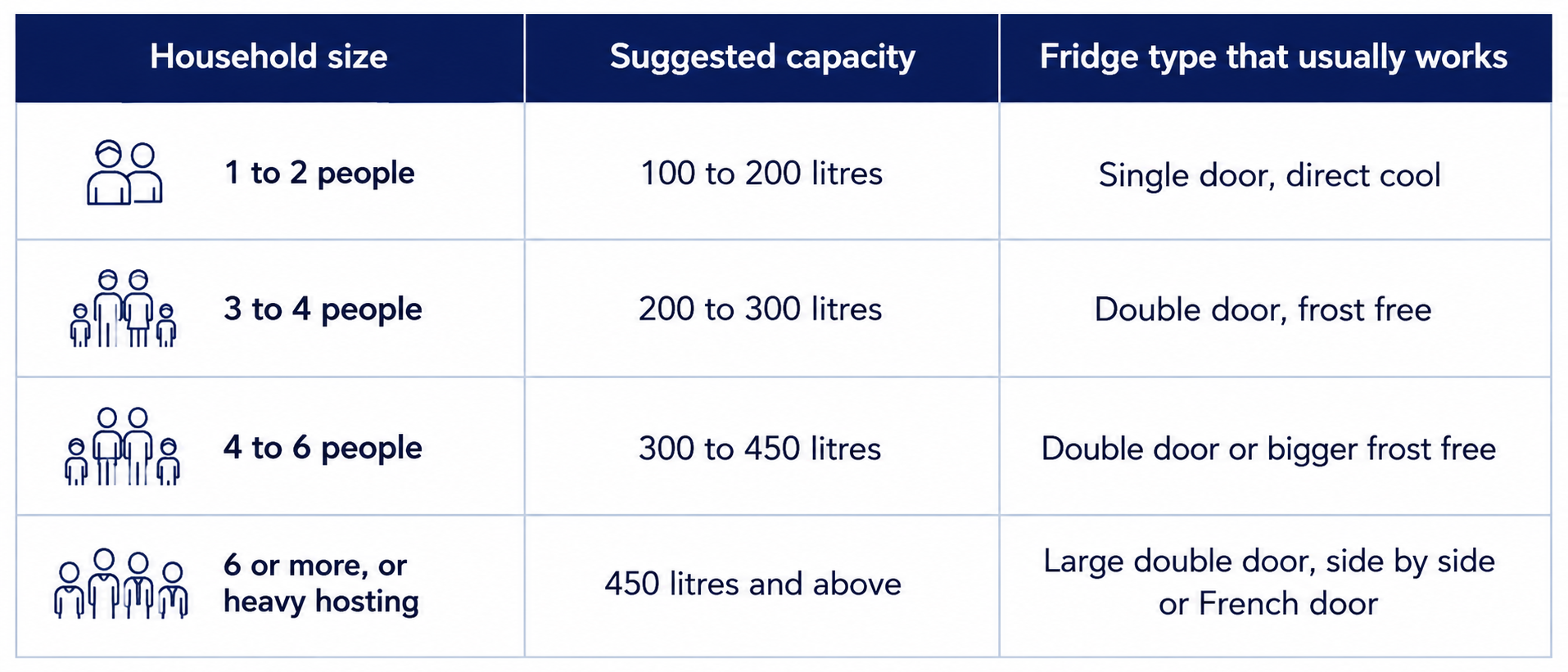
A few notes, because tables always oversimplify.
A couple that cooks a lot might want 250 litres, not 150. A family of four that eats out often might manage fine with 250. These are guides, not laws.
Also, think about the next five years. Is a baby on the way? Are parents moving in? Kids who are small now eat plenty by the time they're teenagers (trust me, a growing teenager can empty a fridge in a single afternoon). If your household is likely to grow, buying one size up is cheaper than replacing the fridge in three years.
Large Capacity Refrigerators: When Bigger Actually Makes Sense
Large capacity refrigerators, usually 450 litres and above, look impressive. Side by side, French door, multi door. They have the wide shelves and the fancy displays. But are they worth the price?They make sense when:
- You have a joint family or a household of six or more.
- You buy groceries in bulk, monthly or even less often.
- You entertain regularly and need space for party food, cakes, drinks and desserts.
- You run a small home business, like baking or tiffin service, and need cold storage.
One more thing nobody mentions. Big doesn't always mean organised. Some large models waste space with odd shelf layouts, so check the interior in person. Open the doors. Slide the shelves. Imagine your actual containers going in. If a showroom lets you carry a steel tiffin box over to test, do it (people look at you strangely, but who cares).
Energy-Efficient Refrigerators: Where the Real Savings Hide
Here's the part where many buyers overspend or underspend. A fridge runs 24 hours a day, every day, for ten years or more. So the electricity it uses matters as much as the sticker price.What to look for in energy-efficient refrigerators:
- Inverter compressor. Instead of switching fully on and off, an inverter compressor adjusts its speed. It's quieter and usually saves a good amount of power. It also handles voltage fluctuations better, which is handy in many Indian cities.
- Good door seals. A worn gasket lets cold air leak out. Press a sheet of paper in the door; if it slides out easily, the seal is weak.
- Right size for you. Yes, again. A fridge that's too big wastes energy, plain and simple.
Small habits help too. Keep the fridge away from the stove and direct sun. Don't put hot food straight inside. Don't open the door every thirty seconds (I know, I know, the snack hunt is real). Set the temperature dial sensibly instead of cranking it to maximum.
Measure Before You Fall in Love
This is the boring section. It's also the one that saves you from the most expensive mistake.Grab a measuring tape and check:
- Space for the fridge itself: Height, width and depth of the spot.
- Ventilation gaps: Fridges need breathing room at the back and sides so heat can escape. Check the manual for exact numbers, but leaving a few centimetres is the usual advice.
- Door swing: Will the door open fully, or bang into a wall or a cabinet? Can the vegetable drawers actually slide out?
- The route in: Measure your main door, lift and staircase turns. I've seen a brand new fridge stuck in a stairwell for an hour. Not pretty.
- Power point: Is there a socket nearby? Use a proper, grounded one, ideally with a voltage stabiliser if your area has an unstable supply.
Final Thoughts
Choosing a fridge doesn't have to be stressful. Start with your household size, add a realistic buffer, then decide between a single door and a double door fridge based on how you actually eat and shop. Go for large capacity refrigerators only if you genuinely need the space. And look closely at energy-efficient refrigerators, because the electricity bill is the quiet part of the cost that keeps arriving every month.Use this refrigerator size guide as your checklist. Measure the space, test the shelves, read the energy label, and ignore the "last piece" pressure. A well chosen fridge should feel invisible: always cold, always roomy enough, never a topic of conversation. That's the one worth buying. And if you're still unsure, go back to the people in your house and ask what they really keep in there. The answer usually settles it. And when you're ready to shop, MediaMarkt is a good place to browse fridges across sizes and budgets.
Shop Your Perfect Fridge Now 🛒
Explore the world of fashion, beauty, lifestyle, and entertainment with Funandflip – your daily dose of trendy tips, style inspiration, and everything fun, fabulous, and fresh in one place!
FAQs
1. What size fridge is best for a family of four?
Most families of four do well with a fridge between 250 and 350 litres. A double door frost free model in this range gives you a proper freezer and enough fresh food space. If you cook in bulk, shop weekly or host often, lean toward the higher end of that range.
2. Is a single door fridge cheaper to run than a double door fridge?
Often, yes, particularly a basic direct cool model, because it has simpler cooling and a smaller body. But the comparison isn't fixed. A modern 4 or 5 star inverter double door fridge can use less power than an older or lower rated single door unit. Always compare the yearly kWh figure on the energy label, not just the door count.
3. Do large capacity refrigerators use more electricity?
Generally they use more total power than smaller ones, since there's more space to cool. However, a well rated large model with an inverter compressor can be more efficient than a poorly rated mid size fridge. The smartest move is to buy only as much capacity as you'll realistically use, and to pick the best star rating your budget allows.