
 Jun 01,2026
 By:
By: Introduction
🏍️ Lift SmarterSo you've finally decided to stop crawling around on a cold garage floor every time your bike needs an oil change. Good call. Finding the best motorcycle lift 2026 has to offer isn't as simple as grabbing whatever's cheapest on the shelf—trust me, I learned that the hard way. There's a real difference between a lift that holds steady at 800 lbs and one that wobbles the moment you lean on it. At Garvee, we carry a solid range of lifts, and we've spent time understanding what actually matters for real-world garage use. This guide covers everything — scissor lifts, hydraulic motorcycle lift options, pneumatic tables, and a few picks that honestly surprised us.
Why You Actually Need a Motorcycle Lift
Look—you can technically do a lot of maintenance with your bike on its kickstand. Technically. But the moment you need to pull a wheel, check the chain tension, or get under the frame, you're going to wish you had a proper lift. Your back will thank you. Your knees will thank you. And honestly? The work just goes faster when the bike is at the right height.A good lift also doubles as a display stand — some guys just like having the bike raised up in the garage. No judgment there. The point is, it's a tool that pays for itself pretty quickly.
What to Actually Look For in the Best Motorcycle Lift 2026
Before we get into the actual picks, let's be real about what separates a good lift from a frustrating one. Not all lifts are created equal—and a few specs matter more than the marketing copy would suggest.- Weight Capacity: This one's obvious, but people underestimate their bike's actual weight—especially touring bikes or loaded adventure rigs. Always go higher than you think you need. A 1,500 lb rated lift for a 700 lb bike? That's not overkill. That's smart.
- Lift Height Range: Some lifts barely get the wheels off the ground. Others go high enough that you don't have to crouch at all. Know what kind of work you're doing and match the lift range accordingly.
- Platform Size: A wider platform means more stability. Smaller platforms are fine for sport bikes but struggle with wide cruisers or trikes.
- Jack Type: Hydraulic? Pneumatic? Manual scissor? Each has trade-offs. A hydraulic motorcycle lift tends to be the most popular because it's smooth, controllable, and doesn't require an air compressor. But pneumatic lifts are faster if you have the setup.
Top-Rated Motorcycle Lifts Available at Garvee in 2026
These aren't just random picks pulled off a spreadsheet. These are lifts that consistently earn solid reviews from riders who actually use them.1. The Heavy-Duty Hydraulic Motorcycle Lift Table (1,500 lb Capacity)
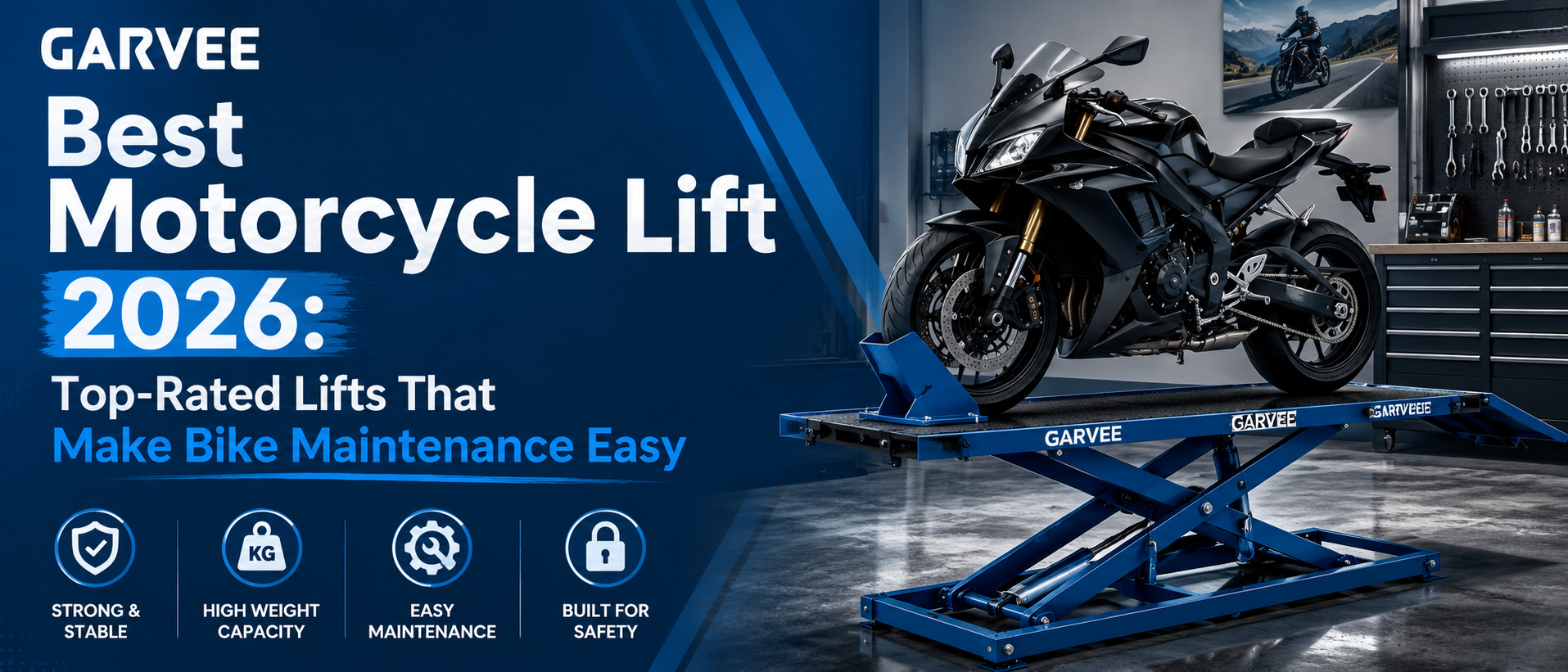
This is the workhorse. If you've got a touring bike or a big cruiser, or you just want something that won't budge no matter what, this is it. The hydraulic motorcycle lift action is smooth and controlled. Pump the foot pedal, and the platform rises steadily. No jerking, no sudden drops. The platform itself is wide enough that even a big V-twin sits on it without feeling like it's going to tip sideways.The wheel vise included is a nice touch—it holds the front wheel firmly so you can remove the rear without needing a buddy standing there holding things steady. Lowering is gradual with a release valve that gives you real control. Honestly, it's the kind of lift that makes you wonder why you waited so long.
2. Scissor Lift Jack with Swivel Saddle (750 lb Capacity)
Not everyone has garage space for a full lift table. That's just reality. If you're working in a tight single-car garage or you store the bike in a shed, a scissor lift jack might honestly be the better call.This one has a swivel saddle that conforms to different frame shapes, which matters more than people realize. Misaligned saddles scratch frames and can slip. The 750 lb rating handles most standard motorcycles just fine. Sport bikes, standards, smaller cruisers — no problem. It's compact, stores easily, and the price point is genuinely hard to argue with.
3. Pneumatic Motorcycle Lift Table with Side Extensions (2,000 lb Capacity)
This one is for the serious home mechanic—or anyone who works on multiple bikes, ATVs, or even light powersports equipment. The pneumatic system means you connect it to an air compressor, and the table rises in seconds. Fast. Really fast, actually. The side extensions broaden the platform significantly, which is a game-changer for wide trikes or three-wheelers.It's heavier and bulkier than the other picks, but the casters roll surprisingly well across a smooth garage floor. If you're doing full engine-out work or rebuilds, this lift's height range and stability are exactly what you need.
4. Compact Low-Profile Hydraulic Motorcycle Lift (600 lb Capacity)
This is the one you want for sport bikes with low ground clearance. Getting a lift under a race-oriented motorcycle can be genuinely annoying—the profile is too high on most standard lifts, and you end up fighting it the whole time. This low-profile hydraulic motorcycle lift design solves that. It slides under with minimal clearance needed and still gets the bike up to a comfortable working height.Lighter bikes, track toys, and naked sport bikes are this lift's sweet spot. It's not trying to handle an 800-pound bagger—and it knows that about itself. There's something refreshing about a tool that's designed for a specific purpose and does it really well.
Hydraulic Motorcycle Lift vs. Other Types — Which Is Right for You?
People ask this a lot. And honestly, the answer depends on what you're working with—not just the bike, but the space, the budget, and how often you're actually in the garage turning wrenches.Hydraulic lifts are the most popular choice among home mechanics. The foot-pump action is intuitive, the rise is smooth, and you don't need any extra equipment. A hydraulic motorcycle lift works straight out of the box—roll the bike on, pump, and you're done. The lowering control is usually very predictable. These are reliable, easy to maintain, and widely available at Garvee.
Pneumatic lifts are faster and easier on the knees — no pumping required. But you need an air compressor that can keep up. If you already have a shop compressor, this might be worth looking at. If not, factor that into the cost.
Manual scissor jacks are the budget-friendly, compact option. Great for occasional use, tight spaces, and riders who don't need to do major work often. The trade-off is effort — you're spinning a handle to raise things, which gets old.
Tips for Using Your Motorcycle Lift Safely
This part sounds obvious. But every now and then someone skips a step and regrets it. A few things that make a real difference:- Always check weight capacity before putting a bike on a new lift. Weigh it if you're not sure — gear, luggage, and accessories add up faster than you'd think.
- Use the wheel vise or tie-down straps when removing wheels. One slip without that front wheel secured, and the whole thing can go sideways—literally.
- Work on a flat, level surface. A slightly sloped driveway is not the place to figure out whether your lift has stability issues.
- Engage the safety lock before crawling under or reaching into tight spots. Hydraulic seals are reliable, but safety locks exist for a reason.
- Keep the lift clean and occasionally check for hydraulic fluid leaks. A small puddle under the lift is worth investigating before it becomes a bigger problem.
Final Thoughts on Finding the Best Motorcycle Lift 2026
Here's the honest summary: the best motorcycle lift in 2026 for you depends on your bike, your garage, and what kind of work you're actually doing. There's no single right answer—but there are definitely wrong answers, and most of them involve buying something that's either undersized, unstable, or built to fail at the worst possible moment.For most riders doing their own maintenance at home, a hydraulic motorcycle lift table in the 1,000–1,500 lb range is the sweet spot. It's versatile, smooth to use, and handles everything from oil changes to full wheel removal without drama. If you're short on space, a scissor jack gets the job done without taking over the garage.
Garvee stocks a range of lifts that are tested, rated for real loads, and actually worth the money. Whether you're a weekend tinkerer or someone who does full engine rebuilds between coffee and noon—having the right lift under your bike changes everything. Don't wait until your back gives you no other option.
🏍️ Lift Smarter
Explore the world of fashion, beauty, lifestyle, and entertainment with Funandflip – your daily dose of trendy tips, style inspiration, and everything fun, fabulous, and fresh in one place!
Frequently Asked Questions
Q1: What weight capacity do I need in a motorcycle lift?
Great question — and one people don't think hard enough about before buying. As a general rule, always pick a lift rated at least 25–30% above your bike's actual curb weight. If your cruiser weighs 750 lbs stock, look at lifts rated 1,000 lbs or higher. Why the buffer? Accessories, luggage, fuel, and the occasional lean-on-the-lift moment all add stress. A hydraulic motorcycle lift rated well above the actual load also tends to last longer because it's never working near its limit. For sport bikes under 500 lbs, a 750 lb rated scissor lift is reasonable. For touring bikes and baggers, go 1,500 lbs minimum.
Q2: Is a hydraulic motorcycle lift better than a pneumatic one?
Both work well — it really comes down to your setup. A hydraulic motorcycle lift is self-contained; you pump a foot pedal and it rises smoothly. No compressor required, no hoses to deal with, nothing to set up. For most home garages, that convenience wins. Pneumatic lifts are genuinely faster and easier on the body for high-frequency use, but they require a sufficiently powered air compressor (usually at least 100 PSI, decent CFM). If you already have a compressor and use your lift constantly, pneumatic might be worth it. If you're a weekend rider doing DIY maintenance, the hydraulic is probably the better call.
Q3: Can I use a motorcycle lift on a sloped garage floor?
Technically possible, but not recommended — especially for anything more than a slight incline. Most motorcycle lifts are engineered for flat, level surfaces. A slope throws off the center of gravity, puts uneven stress on the lift mechanism, and creates a real tipping risk once the bike is elevated. If your garage floor has a slight drainage slope (which many do), use rubber wedge shims under the low side of the lift to level things out before raising the bike. For anything more than a 2–3 degree slope, find a flatter spot or lay down a level platform first. It's not worth gambling on with a 700-pound machine suspended in the air.