
 Jul 20,2026
 By:
By: Introduction
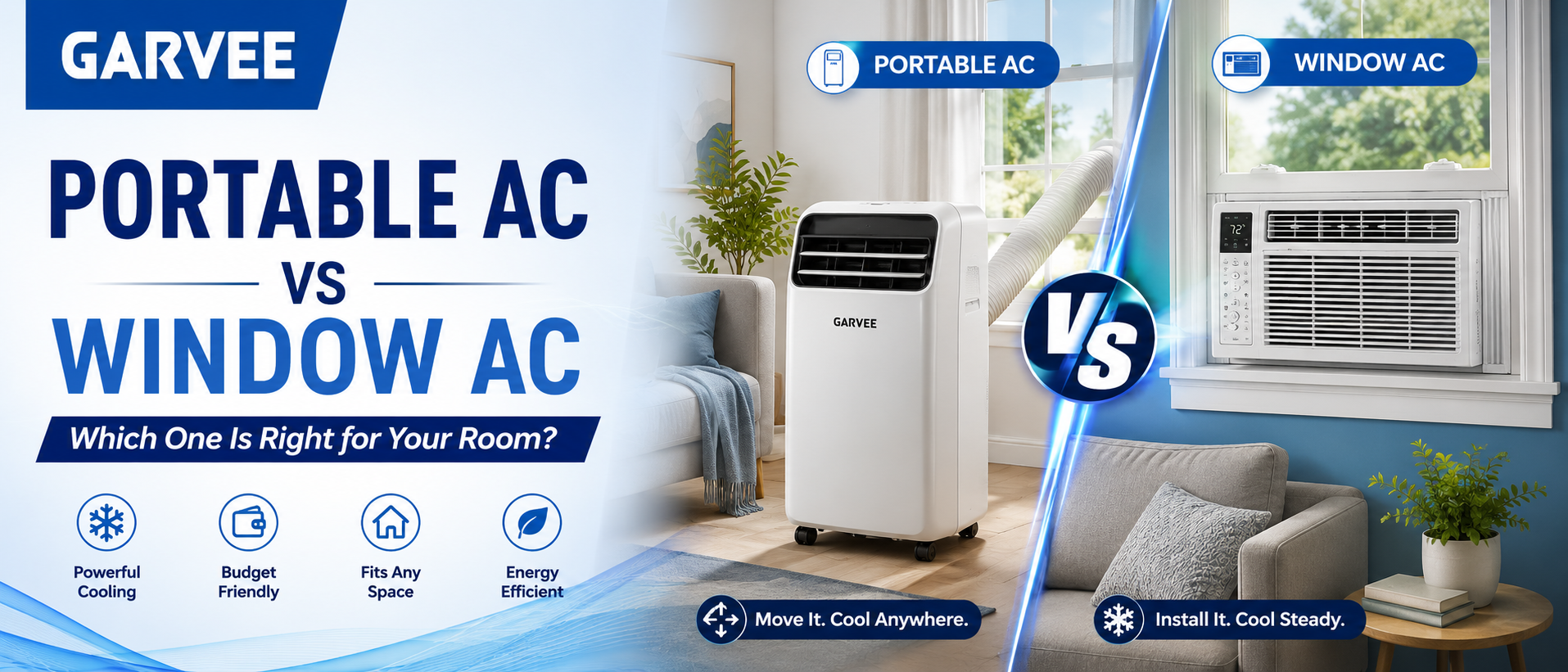
⚡ Choose the Right ACSummer hits, the room turns into an oven, and suddenly you're standing in the appliance aisle staring at two boxes wondering which one will actually save you. That's the real question behind portable ac vs window ac, and honestly, there's no one-size-fits-all answer. It depends on your room, your building, your budget, and how much fiddling you're willing to do on install day.
Garvee offers a wide selection of reliable portable and window air conditioners designed to suit different room sizes, budgets, and cooling needs, making it easier to find the right fit for your home.
I've set up both types over the years (once in a rental where drilling a hole was basically forbidden, once in a house where a window unit made total sense), and the differences show up fast once you actually live with them. Let's get into it.
Portable AC vs Window AC: The Core Differences
When people ask which AC is better, they're usually really asking about three things: how cold does it get, how loud is it, and how much does it cost to run. Let's break each one down.Cooling Capacity
Window units generally win here. Because the whole unit sits in the window, the compressor and condenser coil are outside your room, so less heat leaks back in. A 10,000 BTU window AC is going to cool a room faster and more evenly than a 10,000 BTU portable unit, ish. Portable ACs sit inside the room they're cooling, so the compressor itself generates heat right there in the space, working against itself a little.
Manufacturers get around this by rating portable units with a "SACC" (seasonally adjusted cooling capacity) number instead of straight BTUs, which is honestly more accurate but also confusing if you're comparing across brands without checking the fine print. Always check whether the BTU number you're looking at is SACC-adjusted or not. It matters more than people think.
Airflow
Window units tend to move air more evenly across a room. The vents sit high, near the top of the window, so cool air drops down and circulates. Portable units blow from floor level, which means the area right in front of the unit gets a blast while corners of the room lag behind. If you've got a long, narrow room, or an open floor plan, this becomes noticeable. You'll feel like you're sitting in a wind tunnel three feet from the unit while the far side of the room stays warm.
Cooling Efficiency
This one's not close. Window ACs are simply more efficient, because there's no hose losing cool air or letting outside heat sneak back in through gaps around the vent hose. Portable units lose a chunk of their efficiency just from the single-hose design that most budget models use. Dual-hose portable ACs fix some of this (one hose pulls in air, one pushes hot air out) but they cost more and take up more floor space.
If cooling efficiency and long term energy costs matter to you, and for most people they should, a window unit is usually the smarter buy for the same BTU rating.
Humidity Control
Both types remove humidity as part of the cooling process, that's just how AC works. But window units tend to handle humidity control a bit better in practice because they're not pulling in as much humid outside air through hose gaps and drainage points the way portable units can. If you live somewhere sticky and humid (looking at you, Gulf Coast, Southeast, basically anywhere near the ocean in summer), a window unit will likely leave your room feeling drier and more comfortable at the same temperature setting.
Portable ACs also need somewhere for condensation to go. Some models self-evaporate it through the exhaust hose, others need a bucket you empty manually. Nobody wants to remember to empty a water bucket every other day. I forgot mine once. Not fun.
Which AC Is Better for Your Situation?
Okay, so here's where it gets personal, because "better" really depends on your specific room and living situation.Best AC for Bedroom
For a bedroom, quiet matters more than almost anything else. And this is actually where portable ACs sometimes have an edge, weirdly, some models let you position the loudest part (the compressor) further from your bed than a window unit ever could, since the whole thing sits on the floor and you can angle it. That said, window units installed properly and away from the headboard wall are usually still quieter overall, because portable compressors run inside the room with you, full stop.
If your bedroom window is small or an odd shape, or if you rent and can't install a window bracket, a portable unit becomes the practical choice regardless of the noise tradeoff. Otherwise, for pure cooling comfort and quiet sleep, a window AC placed on the wall opposite your bed tends to win.
Best AC for Apartment
This is honestly where the debate gets the most real. A lot of apartments have lease restrictions on window units, some buildings don't allow them at all because of weight, safety brackets, or historic window frames that can't be modified. In those cases, portable AC isn't just preferred, it's the only legal option.
Portable units also make sense for apartment dwellers who move often. No need to reinstall a heavy window unit every time you relocate, you just roll the portable unit to the new place and vent the hose out whatever window's available. For sliding windows, casement windows, or oddly shaped openings that a window AC bracket just won't fit, portable is really your only realistic path anyway.
But if your apartment allows window units and you've got a standard double-hung window, I'd lean window AC every time. Better cooling, better efficiency, frees up your floor space too, which matters a lot in smaller apartments where every square foot counts.
Which AC Is Cheaper to Run?
Let's talk money, because this is where a lot of people get surprised after the fact.Window ACs are almost always cheaper to run for the same cooling output. Because they're more efficient (see the cooling efficiency section above), they use less electricity to hit and maintain the same temperature. A typical 8,000 BTU window unit might run you somewhere around $30 to $45 a month in electricity with regular summer use, depending on your local rates and how often it's running. A comparable portable unit, because of that inherent efficiency loss, can run 10 to 20 percent higher for the same cooling job. Over a whole summer, that adds up. Not massively, but enough to notice on the bill.
Upfront cost is a different story though. Portable units and window units often sit in similar price ranges at the low end, but portable ACs get expensive fast once you go dual-hose or add smart features. Window units, meanwhile, tend to offer more cooling power per dollar spent.
So if you're asking which AC is cheaper to run long term, window wins. If you're asking which is cheaper to buy and use short term, it's more of a toss-up, and portable might even edge it out for smaller units.
A Quick Word on Installation
I won't pretend installation isn't part of this decision too, because it really is.Window units need a compatible window, a sturdy sill that can support the weight, and usually a support bracket, especially on upper floors (landlords and building codes often require this, for good reason, a window AC dropping from the fourth floor is nobody's idea of a good time). Installation takes maybe 30-60 minutes if you're doing it solo, more if the window's an awkward size.
Portable units, by comparison, are almost stupidly easy. Unbox it, attach the exhaust hose to the included window kit, close the window most of the way around the hose, plug it in. Ten minutes, tops. No tools, no bracket, no worrying about whether your window sill can hold 60+ pounds.
For renters, people with mobility concerns, or anyone who just doesn't want to deal with brackets and tools, that ease of installation alone might settle the whole portable ac vs window ac question.
So, Which One Should You Actually Buy?
Here's my honest take, after going back and forth on this myself more than once. If you own your place, or your building allows window units, and you've got a standard window that fits one, go window AC. You'll get better cooling capacity, better airflow, better humidity control, and lower running costs, basically a win across the board except for the slightly trickier install.If you're renting somewhere that restricts window units, dealing with an odd window shape, or you just move a lot and want flexibility, portable AC is the practical answer. Yes, you'll pay a bit more on your electric bill and deal with a hose running to your window (which never looks great, let's be honest), but you get freedom and easy setup in return.
There's no universally "best" AC. There's only the best AC for your room, your building, and your patience for hardware installation.
Final Thoughts
At the end of the day, portable ac vs window ac isn't really a fight with one clear winner. It's a tradeoff. Window units bring better cooling capacity, stronger cooling efficiency, and lower monthly costs, but they demand a compatible window and a bit of installation effort. Portable units bring flexibility and dead-simple setup, but you'll pay for that convenience in slightly higher running costs and less even airflow.If you're looking for dependable cooling solutions, Garvee offers a range of portable and window air conditioners designed to deliver reliable performance, energy efficiency, and great value for every home.
Think about your room size, your building's rules, how much noise you can tolerate at night, and how long you're planning to stay put. Answer those honestly and the right choice tends to become pretty obvious. Whichever you pick, both will get you through a hot summer. Just maybe not equally cheaply.
⚡ Choose the Right AC
Explore the world of fashion, beauty, lifestyle, and entertainment with Funandflip – your daily dose of trendy tips, style inspiration, and everything fun, fabulous, and fresh in one place!
FAQs
1. Which AC is better for cooling a large room fast?
Window units generally cool large rooms faster because more of the cooling capacity is dedicated to the room itself, rather than being partly lost to the compressor's own heat sitting inside the space like with portable units.
2. Best AC for apartment living when window units aren't allowed?
A portable AC is your best bet here, since it doesn't require permanent installation or a bracket, and can vent through almost any window type using the included kit.
3. Which AC is cheaper to run over a full summer?
Window ACs typically cost less to run because they're more energy efficient for the same BTU rating, though portable units can offset this somewhat with lower upfront prices on smaller models.