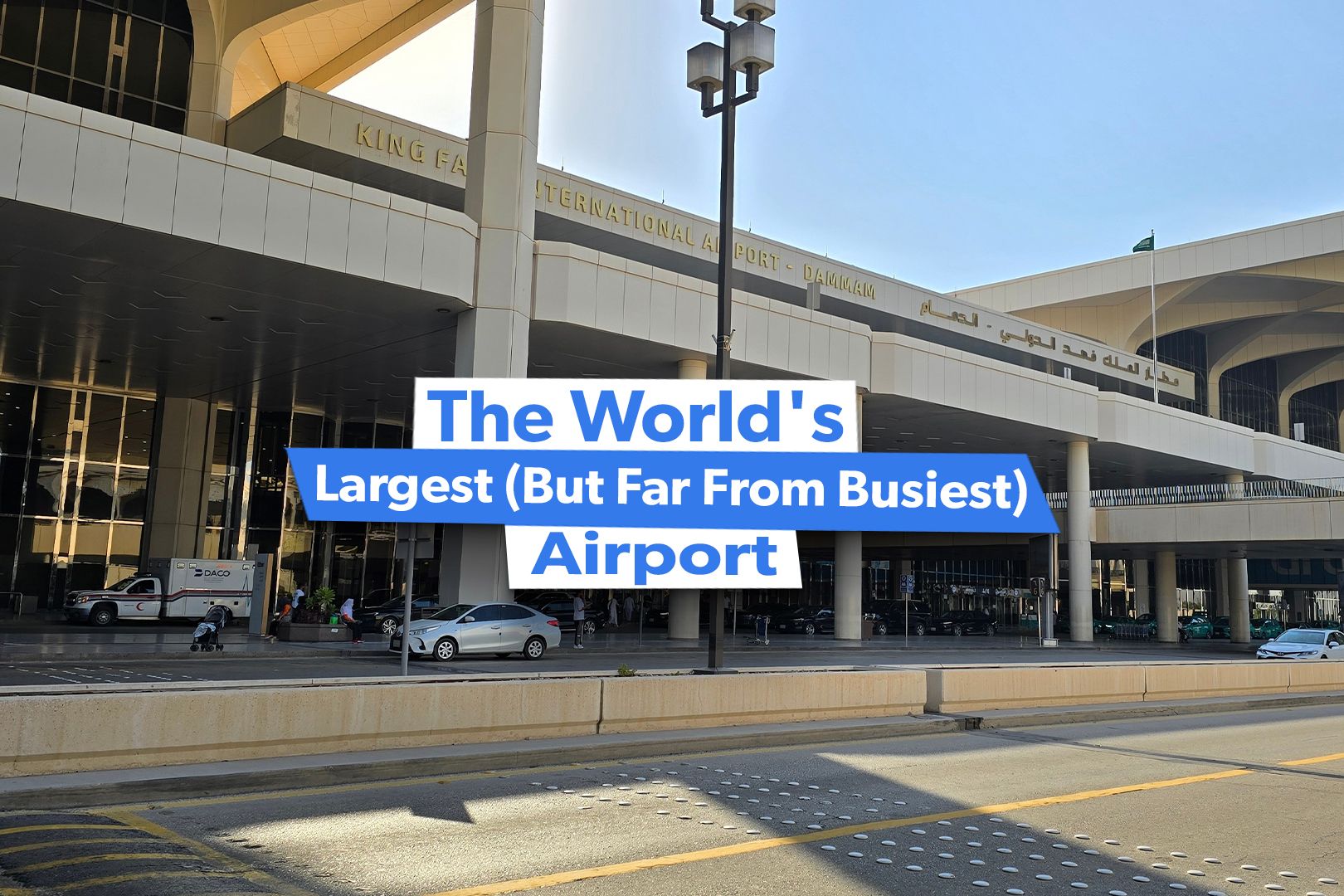


The world's largest airport—King Fahd International Airport (DMM) in Dammam, Saudi Arabia—is more than double the area size of the world's next biggest airport, King Khalid International Airport, also located in Saudi Arabia. At an estimated 300 sq miles, King Fahd International is the same size as the entirety of New York City and almost six times larger than the biggest airport in the United States, Denver International Airport. However, for an airport of such scale, a look at its schedule shows an underwhelming number of commercial flights.
For example, data from aviation analytics company Cirium reveals less than 3,400 flights are scheduled at King Fahd International this February, peaking at 3,841 flights in July. In terms of annual passenger movement, the airport handled around 12 million passengers last year, but in preceding years, this figure has consistently been in the single-digit millions. Compare this to the world's busiest airport—Atlanta Hartsfield-Jackson International—which handles over 1,000 flights every day and over 62 million annual passengers, and it's clear that King Fahd International is definitely underutilized in relation to its size.

So why is such a massive, modern airport so severely underused? King Fahd International - the world's biggest airport King Fahd International recently celebrated its quarter-centenary, having opened for business in late 1999. Up until this point, airlines had been using the nearby Dhahran International Airport,.