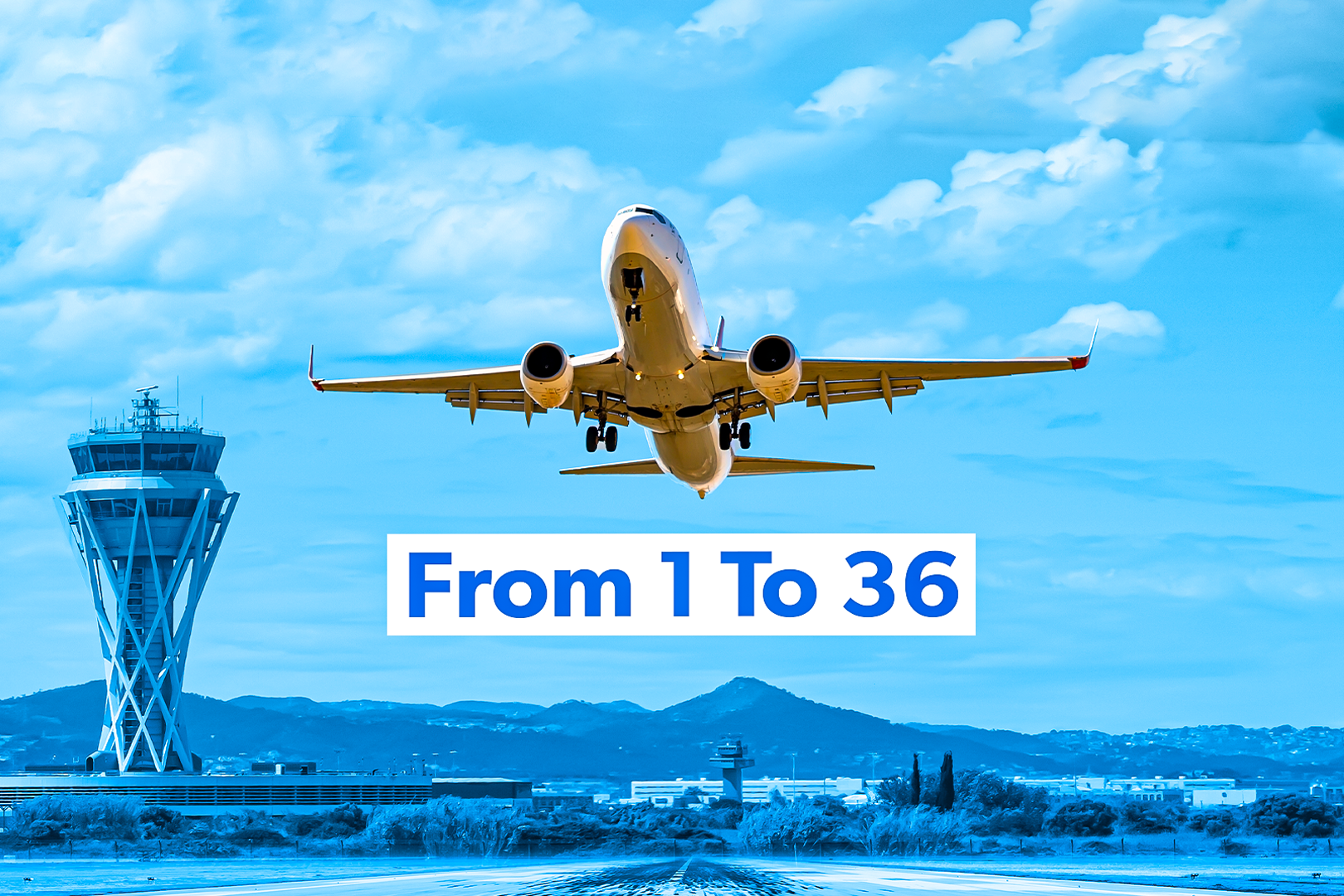


You may have noticed the large painted numbers (or alphanumeric in some cases) on either end of the runways. Have you ever wondered what those represent and why there are a maximum of two numbers between 1 and 36? All runways are numbered based on the magnetic compass bearing, which identifies the direction of the runway. Runway numbers are determined by rounding the compass bearing (up to 360 degrees) at each end of the runway to the nearest 10 degrees and truncating the last digit.
In other words, a 10-degree orientation on one end will be numbered 1, a 360-degree orientation is number 36, and everything in between. That way, each end of the runway is numbered between 1 and 36, depending on its compass bearing. The opposite end of the runway certainly differs by 180 degrees and numbered 18 higher or lower.

If there are multiple parallel runways with the same compass bearing, L (for left) and R (for right) are added as the suffixes. A common example is the two pairs of parallel runways at San Francisco International Airport (SFO), which are numbered as follows: Runway 10L/28R (oriented east-west with 100 degrees on one end and 280 degrees on the other) Runway 10R/28L (oriented east-west with 100 degrees on one end and 280 degrees on the other) Runway 01R/19L (oriented north-south with 10 degrees on one end and 190 degrees on the other) Runway 01L/19R (oriented north-south with 10 degrees on one end and 190 degrees on the other) A small number of airports have three parallel .