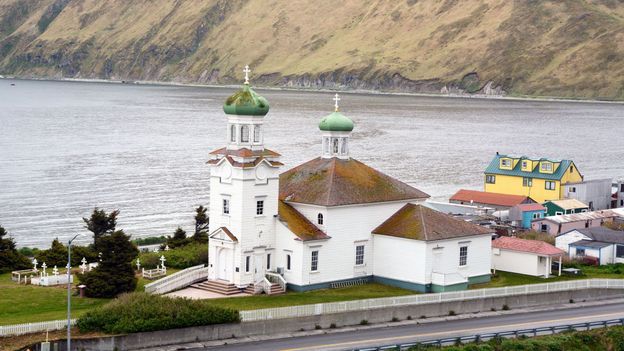


Unalaska Island in the remote Aleutian archipelago was part of an epic, but now mostly forgotten, military campaign during World War Two. Situated where the northern Pacific Ocean meets the Bering Sea, the remote US island of Unalaska straddles the liminal zone where North America transitions into Siberia. The island lies further west than Hawaii; its position on the cusp of East Asia makes it one of Alaska's more remote and idiosyncratic communities.
Part of the Aleutian Islands, a 1,100-mile volcanic archipelago that curves in a westward arc to within 600 miles of Russia's Kamchatka Peninsula, Unalaska features one of the harshest environments on the planet outside the polar regions. The windswept coastlines are rugged, often precipitous and almost entirely devoid of trees. Because of the Aleutians' location in the Pacific Ring of Fire – one of the world's most seismically active areas – earthquakes are ubiquitous, and half of the island chain's 70 volcanoes, including Unalaska's active Makushin volcano, have erupted in the last 250 years.

"Cradle of Storms" and "Birthplace of Winds" are two well-deserved nicknames among locals for the Aleutians. Conflicting weather systems generated in neighbouring seas result in cyclonic storms, hurricane-force winds, heavy rain and dense fog that have a considerable impact upon weather across much of Canada and the continental US. Today roughly 4,200 people call Unalaska home, including fishermen and the Indigenous Unangax̂ people (.